
Are led strip lights a fire hazard?
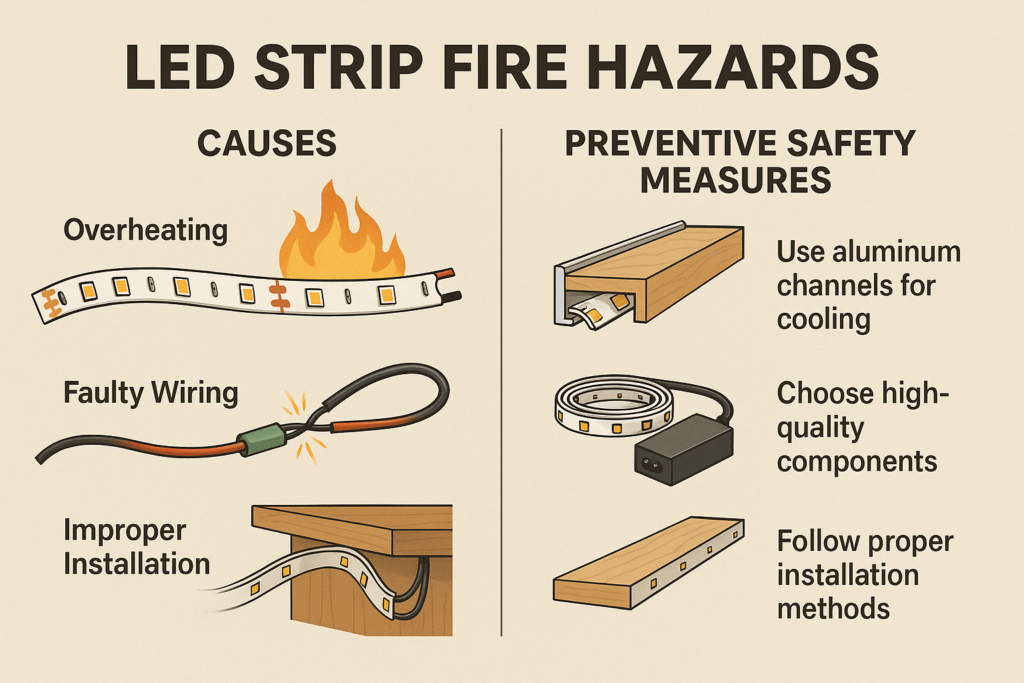
LED strip lights can be a fire hazard, but in normal, correctly-installed setups they’re usually low risk—the problems almost always come from cheap/uncertified products, the power supply (AC adapter/driver), bad wiring/connectors, or overheating from poor heat dissipation.
Elstar
Contents
- 1 Why LED strip lights can start fires (the real failure points)
- 1.1 1) The power supply is the biggest risk
- 1.2 2) Overloading (too many meters on one driver)
- 1.3 3) Wrong voltage (serious)
- 1.4 4) Bad connectors / thin wire / loose joints
- 1.5 5) Trapping heat (installing on/near flammables, or enclosing without airflow)
- 1.6 6) Non-compliant products (real-world safety notices/recalls exist)
- 2 “Are they safe if I buy the right ones?”
- 3 Buying checklist (what to look for)
- 4 Installation rules that prevent 95% of problems
- 5 Red flags (stop using until fixed)
- 6 FAQs
Why LED strip lights can start fires (the real failure points)
1) The power supply is the biggest risk
Most strips run on 12V/24V DC, but they plug into mains power through an adapter/driver. If that adapter is low-quality, overloaded, poorly ventilated, or counterfeit, it can overheat.
2) Overloading (too many meters on one driver)
If your strip setup draws more wattage than the driver can safely provide, heat builds up in wiring, connectors, and sometimes the strip itself. A common best practice is not loading a driver to 100% (leave headroom).
3) Wrong voltage (serious)
Example: plugging a 12V strip into a 24V driver can overdrive components and create overheating/smoke/fire risk.
4) Bad connectors / thin wire / loose joints
Loose contacts create resistance → resistance creates heat. This shows up as browned plastic, flicker, hot-to-touch connectors, or melting.
5) Trapping heat (installing on/near flammables, or enclosing without airflow)
Even LEDs that feel “cool” can build heat over time, especially high-density strips. Fires can start from heat buildup near combustibles even without a flame.
6) Non-compliant products (real-world safety notices/recalls exist)
UK product safety reports have flagged LED strip products sold online as high risk of fire due to issues like insufficient earthing or incorrect fusing that can lead to overheating/ignition.
“Are they safe if I buy the right ones?”
Yes—your goal is to buy a listed/certified system and install it so it can’t overheat.
In the US, low-voltage lighting systems are commonly evaluated to standards like UL 2108 (low-voltage lighting systems).
Buying checklist (what to look for)
- UL Listed / ETL Listed strip + power supply (not just “CE” text printed on a label).
- Class 2 power supply (limits output power/current—safer for many home installs).
- Clear specs: voltage (12V/24V), watts per meter, max run length, and wiring guidance.
- Avoid “too cheap to be true,” off-brand adapters, and suspicious listings.
Installation rules that prevent 95% of problems
- Do the wattage math
- Total watts = (watts per meter) × (meters used)
- Pick a driver with ~20–30% headroom (don’t run it at the limit).
- Match voltage exactly
- 12V strip → 12V driver; 24V strip → 24V driver.
- Don’t coil or bunch lit strips
Coiling concentrates heat. - Give heat a place to go
For brighter/high-density strips, use an aluminum channel/profile (acts like a heat sink) and avoid sealing them into tiny unventilated spaces. - Place the power supply in open air
Not under pillows, inside insulation, or buried behind curtains/fabric. NFPA’s general electrical safety guidance is basically: don’t let heat build up near things that burn. - Use proper wire gauge + solid connections
If connectors get warm, replace with better connectors or solder + heatshrink (and strain relief). - Avoid sketchy power strips/extension cords
Don’t add fire risk upstream by overloading outlets and power strips.
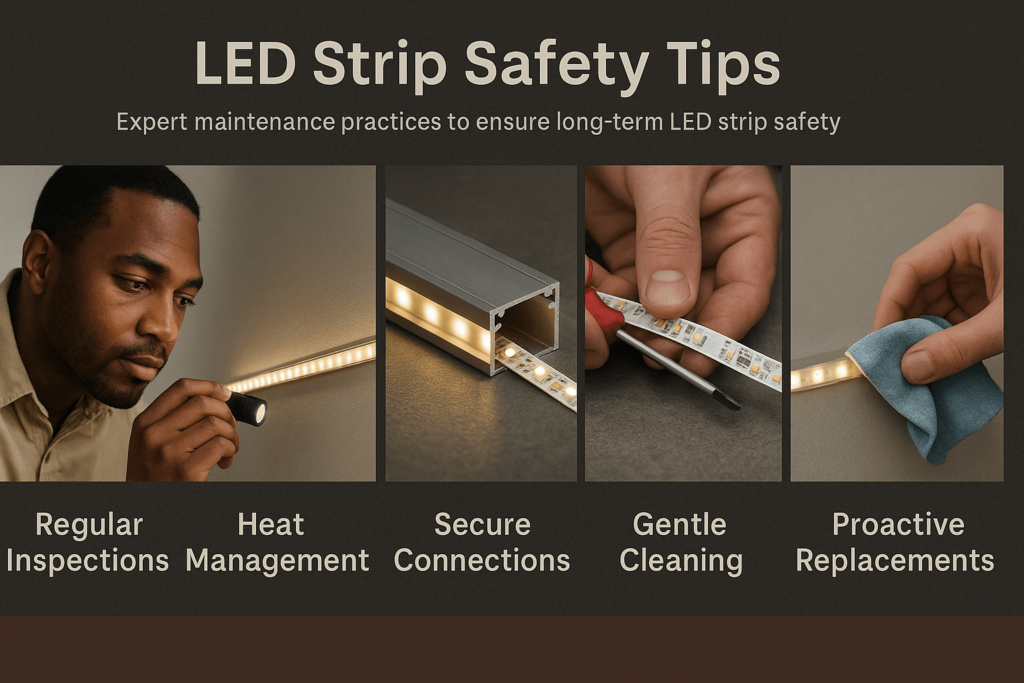
Red flags (stop using until fixed)
- Adapter/driver is hot to the touch, buzzing, or smells like hot plastic
- Flickering when it shouldn’t
- Discoloration, melting, brittle connectors, browned tape/adhesive
- The strip is installed on fabric/wood and gets warm over time
FAQs
Can I leave LED strips on all night?
Usually yes if the system is listed, correctly powered, ventilated, and not overheating. The bigger concern is the driver heating up over long periods.
Are “USB LED strips” safer?
Lower voltage helps, but the risk shifts to cheap USB power bricks, thin wires, and poor connectors. Treat them the same: reputable power supply + ventilation.
Biggest single upgrade for safety?
A quality listed/Class 2 power supply sized with headroom, plus avoiding heat traps.
READ ALSO: Installing led lights in ceiling